

Winter 2025 | Edition 35


Navigating Large Load Proposals in the Modern Utility Landscape
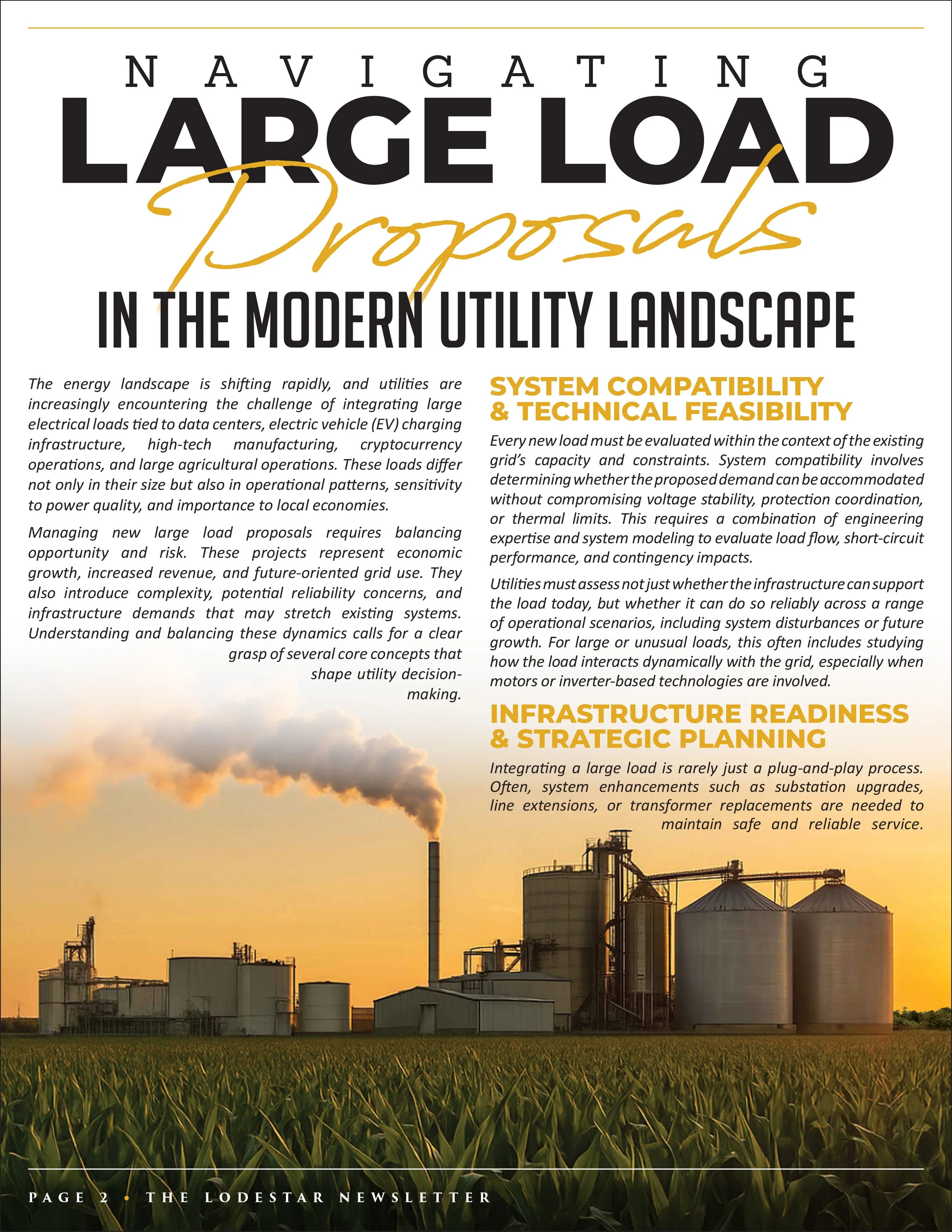
The energy landscape is shifting rapidly, and utilities are increasingly encountering the challenge of integrating large electrical loads tied to data centers, electric vehicle (EV) charging infrastructure, high-tech manufacturing, cryptocurrency operations, and large agricultural operations. These loads differ not only in their size but also in operational patterns, sensitivity to power quality, and importance to local economies.
Managing new large load proposals requires balancing opportunity and risk. These projects represent economic growth, increased revenue, and future-oriented grid use. They also introduce complexity, potential reliability concerns, and infrastructure demands that may stretch existing systems. Understanding and balancing these dynamics calls for a clear grasp of several core concepts that shape utility decision-making.
System Compatibility & Technical Feasibility
Every new load must be evaluated within the context of the existing grid’s capacity and constraints. System compatibility involves determining whether the proposed demand can be accommodated without compromising voltage stability, protection coordination, or thermal limits. This requires a combination of engineering expertise and system modeling to evaluate load flow, short-circuit performance, and contingency impacts.
Utilities must assess not just whether the infrastructure can support the load today, but whether it can do so reliably across a range of operational scenarios, including system disturbances or future growth. For large or unusual loads, this often includes studying how the load interacts dynamically with the grid, especially when motors or inverter-based technologies are involved.
Infrastructure Readiness & Strategic Planning
Integrating a large load is rarely just a plug-and-play process. Often, system enhancements such as substation upgrades, line extensions, or transformer replacements are needed to maintain safe and reliable service. Infrastructure readiness focuses on both the physical condition of assets and their ability to scale with new demand.
Forward-looking planning is essential. The timeline for building or upgrading infrastructure can span months or even years, particularly if permitting, land acquisition, or supply chain limitations are involved.
Financial Responsibility & Rate Strategy
The introduction of a large load carries significant financial implications. Beyond capital upgrades, there are ongoing operational and maintenance costs, as well as questions around fairness in cost allocation. Utilities must carefully consider how to structure cost recovery, especially when the proposed load has a different profile than traditional consumers.
Rate structures should reflect cost causation. Tailored rate design, which may involve custom tariffs or load-specific pricing models, can help balance the needs of the utility with consumer expectations.
Regulatory & Environmental Alignment
Large load projects must also comply with regulatory and environmental requirements. This includes operating within a tightly regulated environment that involves environmental regulators, local zoning authorities, and community stakeholders.
Regulatory alignment extends beyond compliance; it includes stakeholder engagement, transparency, and environmental stewardship. Proactively involving communities and regulators in the planning process can help avoid delays.
Operational Flexibility & Risk Management
As grid conditions become more dynamic, utilities must design their systems not just for normal operation but for resilience under stress. Large new loads can introduce vulnerabilities—such as increased exposure to voltage sags, harmonic distortion, or service interruptions—that require updated contingency planning and risk mitigation strategies.
Operational flexibility, therefore, becomes a cornerstone of system design. Whether through demand-response mechanisms, redundancy in feeder design, or improved monitoring and control, utilities can better prepare for a wider range of scenarios.
Consumer Partnership & Long-Term Engagement
Managing large load growth is not just an engineering or financial challenge—it’s a relationship-building exercise. Large consumers often have complex, evolving needs and significant influence within a utility’s service area. Proactive communication builds trust and ensures that projects meet timelines, expectations, and success criteria.
Consumer partnership involves ongoing engagement: ensuring that load forecasts remain accurate, operations are monitored for deviations, and future expansions are anticipated. For utilities, this means developing internal processes that go beyond basic project review to include ongoing collaboration, education, and service planning.
Integrated Support from STAR Energy Services
In this evolving environment, utilities don’t need to face these challenges on their own. STAR Energy Services offers engineering analysis, system design, financial modeling, and rate development to support utilities from concept to connection. Acting as an extension of your internal team, STAR brings deep utility expertise and a practical, client-centered approach.
By taking a comprehensive view of new large loads and working with the right partners, utilities can turn potential disruptions into opportunities for innovation, community growth, and long-term grid strength.
Happy Holidays from STAR Energy Services!
"May the season fill your days with peace, joy, and fond memories —and the year ahead with new opportunities."