Spring 2026 | Edition 36


Work Order Inspections: Why They Matter & What We Find in the Field
The practice of utilities inspecting work orders originated with the Rural Utilities Service (RUS). Established in 7 CFR Part 1724, Subpart C § 1724.32, RUS requires electric utility borrowers to inspect a representative and sufficient amount of newly completed work orders to ensure the construction conforms to RUS specifications and the standards and requirements of the National Electric Safety Code (NESC), State Codes, and any applicable local codes.
The inspection of work orders has evolved into a best practice for all electric utilities, regardless of their financing sources. Regular inspections strengthen operations, protect assets, and promote accountability across the organization. Reasons to regularly perform work order inspections include:
To ensure conformity with design specifications and the electrical codes of the project construction.
To confirm the quality of workmanship by utility crews and contractors.
To provide documentation for regulatory reviews — documented inspections demonstrate strong internal controls and provide clear evidence that projects were completed as recorded.
To demonstrate good governance — work order inspections reflect sound stewardship of utility assets and ratepayer funds. They reinforce transparency, accountability, and trust with boards, regulators, and members.
Work order inspections are not just a compliance activity—they are a best practice. Utilities that inspect work orders gain stronger systems and reduce risk. Work order inspections also give utilities a valuable opportunity to strengthen construction practices by identifying issues early, correcting them, and sharing lessons learned internally to prevent similar problems in the future.
Common Concerns Found in Work Order Inspections
Grounding:
Insufficient wire size used for the grounding loop in underground enclosures
Using aluminum crimps on copper wire
No bonding between electric and communications enclosures
Distance between ground rods
Guying:
Insufficient separation between anchor rods (multiple down guys require 5 feet of separation)
Insufficient clearance from neutral (down guys require 6 inches of clearance)
———
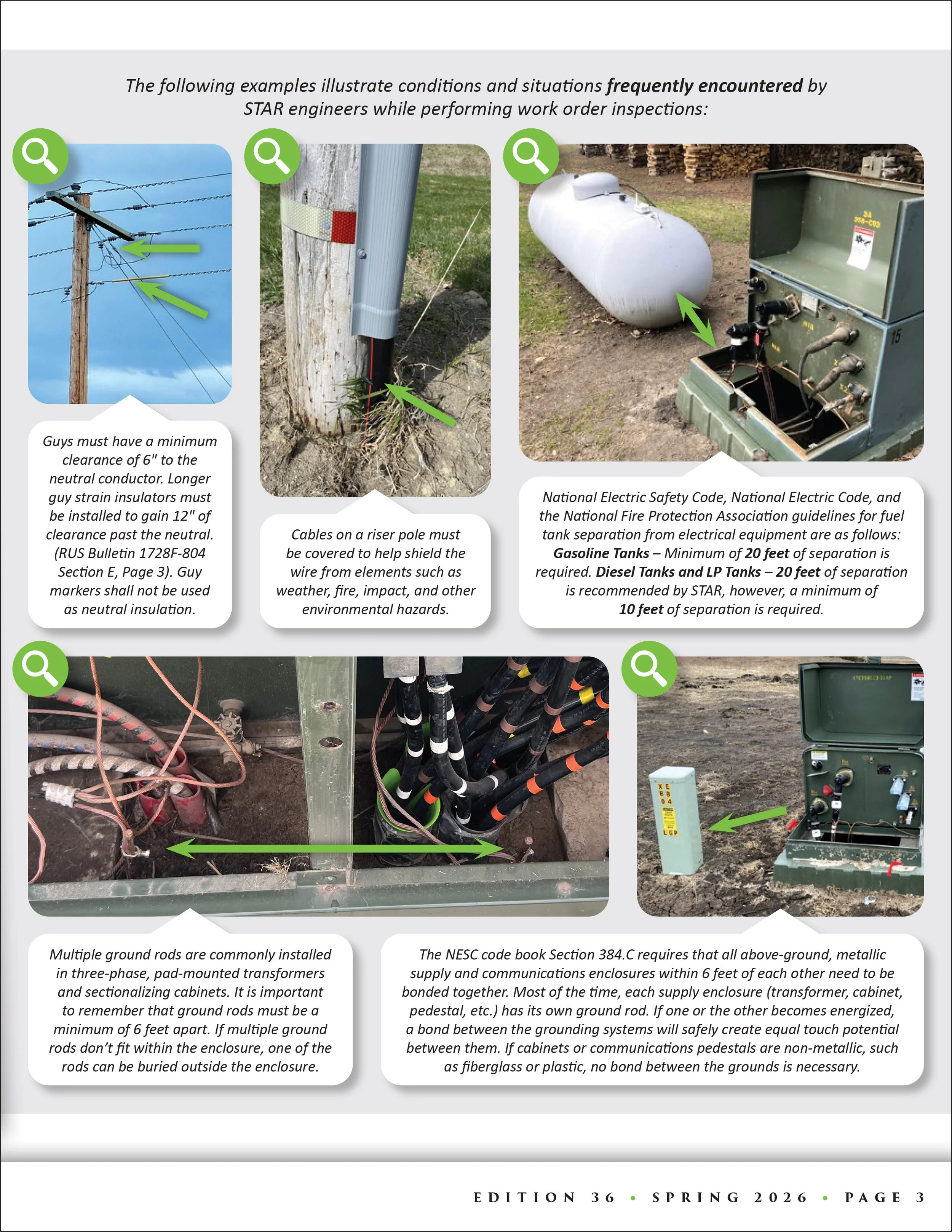
The following examples illustrate conditions and situations frequently encountered by STAR engineers while performing work order inspections:
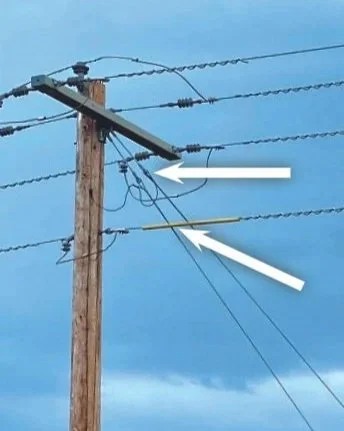
Guys must have a minimum clearance of 6" to the neutral conductor. Longer guy strain insulators must be installed to gain 12" of clearance past the neutral. (RUS Bulletin 1728F-804 Section E, Page 3). Guy markers shall not be used as neutral insulation.
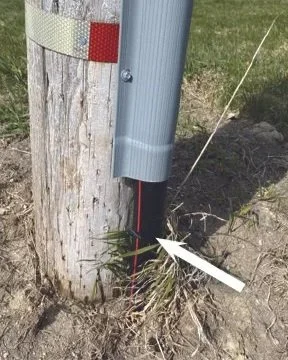
Cables on a riser pole must be covered to help shield the wire from elements such as weather, fire, impact, and other environmental hazards.
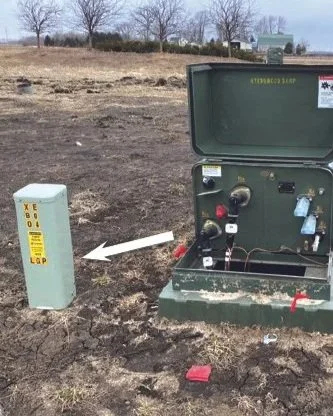
The NESC code book Section 384.C requires that all above-ground, metallic supply and communications enclosures within 6 feet of each other need to be bonded together. Most of the time, each supply enclosure (transformer, cabinet, pedestal, etc.) has its own ground rod. If one or the other becomes energized, a bond between the grounding systems will safely create equal touch potential between them. If cabinets or communications pedestals are non-metallic, such as fiberglass or plastic, no bond between the grounds is necessary.
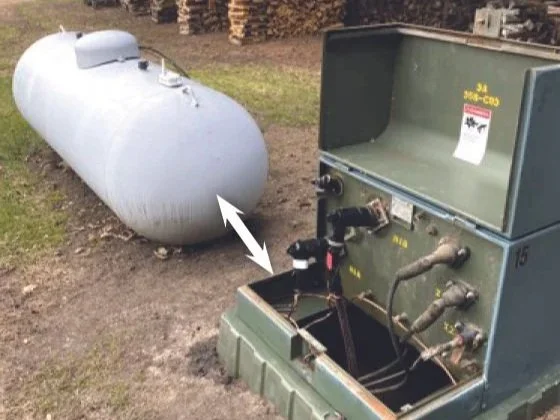
National Electric Safety Code, National Electric Code, and the National Fire Protection Association guidelines for fuel tank separation from electrical equipment are as follows: Gasoline Tanks – Minimum of 20 feet of separation is required. Diesel Tanks and LP Tanks – 20 feet of separation is recommended by STAR, however, a minimum of 10 feet of separation is required.
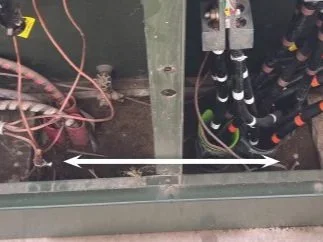
Multiple ground rods are commonly installed in three-phase, pad-mounted transformers and sectionalizing cabinets. It is important to remember that ground rods must be a minimum of 6 feet apart. If multiple ground rods don’t fit within the enclosure, one of the rods can be buried outside the enclosure.
———
The information provided is intended for general educational and informational purposes only and does not constitute legal, engineering, or regulatory advice. Each electric utility operates under its own unique circumstances, regulatory obligations, and system conditions, which should be evaluated independently. Utilities should consult with their qualified engineers, legal counsel, insurers, and other professional advisors to determine how applicable requirements, inspection practices, and compliance obligations apply to their specific system.
Upcoming Event: DER Workshop
Join us for a half-day DER Workshop featuring a DER Interconnection Process refresher presented by Kristi Robinson, PE, Director of Operations. This focused session will walk participants through the key steps of the interconnection process, including technical requirements, applications, and agreements used by utilities when working with distributed energy resource (DER) systems. The refresher is designed to reinforce understanding, clarify common questions, and support effective coordination between utilities and DER stakeholders.
Following the process refresher, Melissa Knott, Senior Software Developer, will walk you through several powerful NOVA Power Portal™ Tips and Tricks.
Thursday, April 16, 2026
9:00 AM to 2:30 PM
The Boathouse — Legacy of the Lakes Museum, 205 3rd Ave W, Alexandria, MN 56308
$50 per ticket (includes lunch)
Register to Attend Below by April 1st